Electrochemistry and Corrosion Engineering

Paper
Improvements of Corrosion Resistance and Antibacterial Properties of Hydroxyapatite/Cupric Oxide Doped Titania Composite Coatings on Degradable Magnesium Alloys
Release Time:2026-01-13
Hits:
Links to Published Journals:
https://pubs.acs.org/doi/10.1021/acs.langmuir.0c02442
Indexed by:
Journal Article
First Author:
Yingchao Xu
Correspondence Author:
Yunting Guo,Guangyu Li
Co-author:
王天笑,Jianshe Lian
Date of Publication:
2020-11-10
Journal:
Langmuir
Included Journals:
SCI
Document Type:
J
Volume:
36
Issue:
46
Page Number:
13937-13948
ISSN:
0743-7463
Key Words:
Alloys, Coating materials, Composites, Electrochemistry, Oxidation
Abstract:
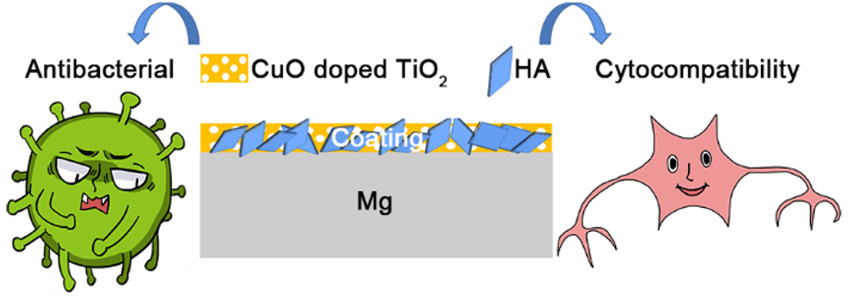
The excellent biocompatibility of calcium phosphate (CaP) coatings makes them widely used in magnesium (Mg) alloy orthopedic implant materials. However, the porous morphology of CaP coatings limits their corrosion resistance. A cupric oxide (CuO) doped titania (TiO2) sol–gel coating is prepared on a porous hydroxyapatite (HA) coating. According to electrochemical test results, the HA/CuO–TiO2 coating obtains a current density of 6 × 10⁻⁴ mA/cm2, lower than that of the Mg alloy (2.6 × 10⁻² mA/cm2). The hydrogen evaluation of the HA/CuO–TiO2 coating is only 1/12 that of the Mg alloy after immersion for 7 days. In addition, the HA/CuO–TiO2 coating has an antibacterial rate of 99.5 ± 0.4% against Staphylococcus aureus, significantly higher than that of the HA coating (19.8 ± 0.3%) and HTC0 coating (38.4 ± 0.5%). The CuO doped composite coating has no adverse effect or cytotoxicity on cell proliferation (cell viability ≥79.6%). Hence, the HA/CuO–TiO2 composite coating is useful for enhancing the corrosion resistance and antibacterial properties of Mg alloys while ensuring cytocompatibility. The HA/CuO–TiO2 coated AZ60 Mg alloy can meet the requirements of clinical application.
DOI Number:
10.1021/acs.langmuir.0c02442
Impact Factor:
3.9